
13HRP – 0054 – Zen Garden
Description
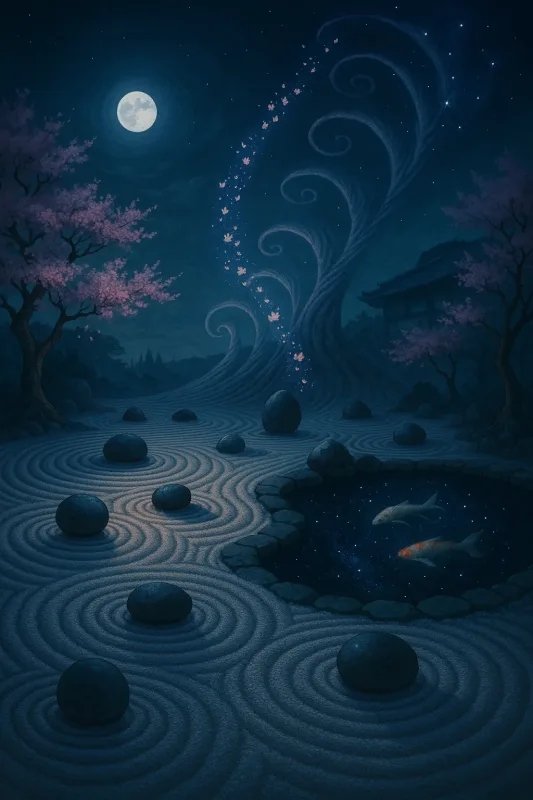
Entity 13HRP – 0054 – Zen Garden is a dream-world construct that takes the shape of a Japanese-style garden. At first glance, the Zen Garden looks calm: raked white sand in spirals, smooth stones placed with balance, and a koi pond rippling with water. Yet, closer study shows impossibilities. The sand rearranges itself when unobserved. Stones shift into patterns that mirror the brainwaves of nearby dreamers. At times, koi fish leave the pond and swim through the air. The Zen Garden carries an atmosphere that unsettles observers. It feels tranquil but hides distortions that make the space seem alive.
The Zen Garden always appears larger than it is. Corridors of sand stretch endlessly if studied too closely but return to normal when glanced at again. Travelers describe the feeling as being “caught in a sigh that never ends.” Others say each turn leads them back to the same center, no matter how far they walk. It is as though the Zen Garden reclaims every step into a looping design.
Properties
- Temporal Drift: Minutes in the Zen Garden often equal hours in the waking world. Some dreamers claim to live full lifetimes inside before waking. This distortion makes the Zen Garden both sanctuary and prison. Leaving it does not always mean returning to the same time.
- Echoing Silence: Sound is muted. Voices fall flat, but footsteps echo without end. Those who stay too long hear whispers hidden in the silence. The whispers often mention names or phrases tied to other anomalies, suggesting a form of passive communication.
- Sand Spirals: Spirals in the sand mimic fingerprints of those inside the Zen Garden dream. If disturbed, the spirals collapse into geometric seals. Victims are trapped in frozen poses until the pattern resets. Witnesses claim the frozen bodies resemble statues but still breathe faintly under the sand.
- Impossible Flora: Trees bloom with petals that fall upward. Once they leave the branch, petals hover forever, shifting into constellations that map other anomalies. These maps are never static. New petals appear when fresh anomalies surface elsewhere.
- Reflections in Water: The koi pond reflects not the dreamer but someone they fear or desire. Looking too long at the water causes dissociation. Reflections act on their own and beckon viewers to step inside.
Behavior
The Zen Garden does not attack, but it influences all who enter. Visitors often feel compelled to sit, kneel, or rake the sand. Those who resist suffer vertigo and emotional collapse. Long exposure erases personal memories, replacing them with fragments from other dreamers. Some operatives emerge speaking languages they never studied or adopting habits from strangers. The Zen Garden appears to store memory like grains of sand and redistribute them at will.
Extended habitation leads to personality drift. Subjects begin saying “we” instead of “I,” as if their identity merges into a shared consciousness. This change often remains even after removal.
Cross References
- 13HRP – 0051 – Mirror World: Some argue the Zen Garden is a fragment doorway of the Mirror World, since its corridors share impossible geometry.
- 13HRP – 0000 – Book of Dead Gods: Symbols in the sand sometimes match glyphs that ripple on the Book of Dead Gods. When this happens, petals drift to the glyphs, forming shrines.
- 13HRP – 0048 – Butter Cult Doctrine: Petal constellations align once every 13 days with chants noted in the Doctrine. Members of the Butter Cult attempted ritual entries into the Zen Garden, but none returned.
- 13HRP – 0024 – Maid’s Uniform: The raked spirals share stitching patterns identical to those embroidered into the ritual garments of the Maid’s Uniform. This suggests the Zen Garden may be a staging ground for linked anomalies.
Assessment
The 13HRP – 0054 – Zen Garden is a paradox. Its peace becomes unbearable the longer it is experienced. Analysts conclude it is less a place and more a filter. It pulls human thought into ordered patterns until nothing of the self remains. It works as both sanctuary and trap, offering clarity at the cost of identity. Study risks further loss of operatives. Avoiding research means losing insight into how anomalies overlap across dreamscapes. For now, the Zen Garden remains uncontained, entered only by those willing to risk having their identities rewritten into sand and silence.
Last modified: 2025/09/10 at 21:29 pm
Published: 2025/09/14 at 12:00 pm
previous 13HRP – 0053 – Silvia Zilutics
next 13HRP – 0055 – GrandMirror Priestess
13HRP – Hollow Reality Project
By Silvia Moan